


Underpads are absorbent protective pads designed to prevent urine and other liquids from reaching mattresses, chairs, and surrounding surfaces. They are widely used in hospitals, nursing homes, home care, and other environments where reliable moisture protection is needed.
But what are underpads made of, and how do their materials affect performance?
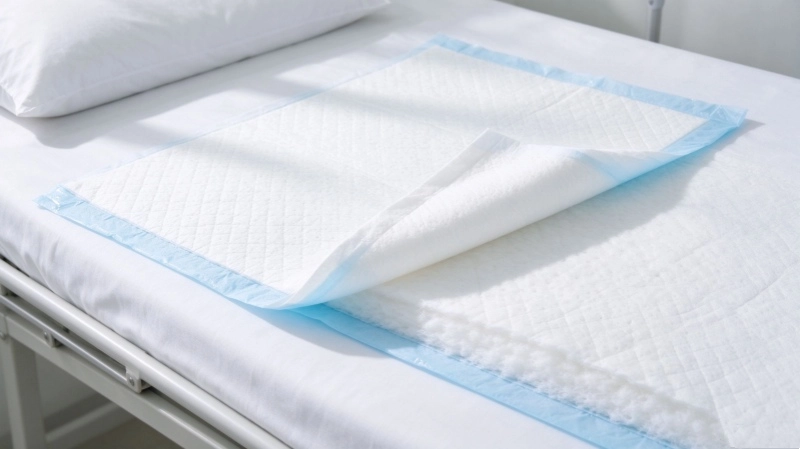
Most disposable underpads feature a multi-layer structure combining a soft topsheet, an absorbent core, and a waterproof backing. Each layer performs a specific function, from allowing liquid to penetrate quickly to retaining moisture and preventing leakage.
Understanding these materials makes it easier to select underpads with the right absorbency, comfort, and protection for different applications.
1. What Materials Are Used in Disposable Underpads?
Although construction varies depending on the product specification, most disposable underpads contain several functional layers that work together to manage liquid effectively.
| Layer | Common Materials | Main Function |
| Topsheet | Nonwoven fabric | Allows liquid to penetrate while providing a soft contact surface |
| Absorbent Core | Fluff pulp and SAP | Absorbs, distributes, and retains liquid |
| Tissue Layer (Optional) | Tissue paper | Helps support the absorbent structure |
| Backsheet | PE film or laminated material | Prevents liquid from reaching underlying surfaces |
Nonwoven Fabric Topsheet
The topsheet is the uppermost layer of an underpad. It typically consists of soft nonwoven fabric designed to allow liquid to pass through into the absorbent core.
A well-designed topsheet helps reduce moisture accumulation on the surface, improving comfort during use. Its softness, liquid permeability, and compatibility with the absorbent layer all influence the overall performance of the product.
Fluff Pulp and Super Absorbent Polymer (SAP)
The absorbent core is responsible for capturing and retaining liquid.
Fluff pulp provides a fibrous structure that helps absorb and distribute moisture throughout the core. SAP, or super absorbent polymer, can absorb and retain substantial amounts of liquid relative to its own weight under suitable conditions.
These materials are often combined to balance absorption speed, liquid distribution, and retention. However, not all disposable underpads contain SAP, and the proportion of each material varies according to the intended absorbency level.
Waterproof PE Backsheet
The bottom layer is commonly made from polyethylene (PE) film or a laminated waterproof material.
Its primary function is to prevent absorbed liquid from passing through the underpad and reaching mattresses, bedding, or furniture. The integrity of this layer is essential for reliable leakage protection.
2. How Do Underpad Materials Affect Absorbency and Protection?
Material selection directly influences how an underpad performs. While two products may appear similar, differences in their absorbent cores, surface materials, and backing construction can lead to noticeable differences in practical use.
Absorption and Liquid Retention
High-absorbency underpads typically use a combination of fluff pulp and SAP to improve liquid management.
Fluff pulp helps distribute incoming liquid, while SAP contributes to moisture retention. However, increasing SAP content alone does not automatically guarantee better performance. The distribution of absorbent materials and the overall core structure also affect how efficiently liquid is absorbed.
For this reason, absorption speed, total capacity, and liquid retention should be evaluated together rather than relying on a single advertised absorbency figure.
Surface Dryness and Comfort
Surface dryness depends on how quickly liquid moves through the topsheet and how effectively the absorbent core retains it.
An underpad with poor liquid transfer may leave moisture on the surface even when its core has sufficient absorption capacity. Similarly, liquid may return toward the surface when pressure is applied, a phenomenon known as rewet.
Soft, liquid-permeable topsheets combined with an appropriately designed absorbent core can help minimize surface moisture and improve comfort.
Waterproof Protection and Structural Stability
Reliable protection also depends on the backsheet and overall product construction.
A waterproof backing helps prevent liquid penetration, while a stable absorbent structure reduces the likelihood of core displacement during handling and use.
The dimensions of the underpad also matter. Even a highly absorbent product may provide insufficient protection if it does not adequately cover the intended surface.
3. How to Choose the Right Underpad Materials for Different Applications?
Choosing suitable underpads requires matching material construction and absorbency with actual usage conditions. A product designed for occasional moisture protection may not provide the same performance as one intended for more demanding care environments.
For Hospitals and Nursing Care
Disposable underpads with soft nonwoven topsheets, absorbent cores, and reliable waterproof backing are commonly used to protect beds and examination surfaces.
Where greater liquid capacity is required, products combining fluff pulp and SAP may be appropriate. Surface dryness and structural integrity should also be considered, particularly when underpads are used during extended care periods.
For Home and Elderly Care
For everyday home care, comfort, convenient disposal, and appropriate dimensions are important considerations.
Lightweight disposable underpads may be suitable for occasional leakage, while higher-absorbency options can provide additional protection when greater liquid volumes are expected.
Choosing the correct size is equally important. The underpad should adequately cover the area requiring protection without excessive folding or movement.
For Pet Care and Other Applications
Underpads can also be used for pet hygiene and temporary surface protection. In these situations, liquid absorption, waterproof backing, and convenient replacement are often the main priorities.
However, products should be selected according to their intended application. Materials and specifications suitable for human care are not automatically optimized for pet use.
What Should You Check Before Selecting Underpads?
Beyond the basic material composition, several product specifications can help determine whether an underpad is suitable for its intended purpose:
-
Absorbency: Check liquid capacity, absorption speed, and retention performance.
-
Dimensions: Select sufficient coverage for the bed, chair, or other protected surface.
-
Material construction: Consider topsheet softness, absorbent core composition, and waterproof backing.
-
Product consistency: Review samples and available specifications to assess construction and performance.
For products intended for repeated institutional use or private-label supply, consistent material quality and clearly defined specifications are particularly valuable.
The effectiveness of underpads ultimately depends on how their individual layers work together. A soft topsheet, properly designed absorbent core, and reliable waterproof backing each contribute to moisture management and surface protection.
Understanding these material differences makes it easier to choose disposable underpads that balance absorbency, comfort, and leakage resistance without relying solely on thickness or advertised absorption capacity.


